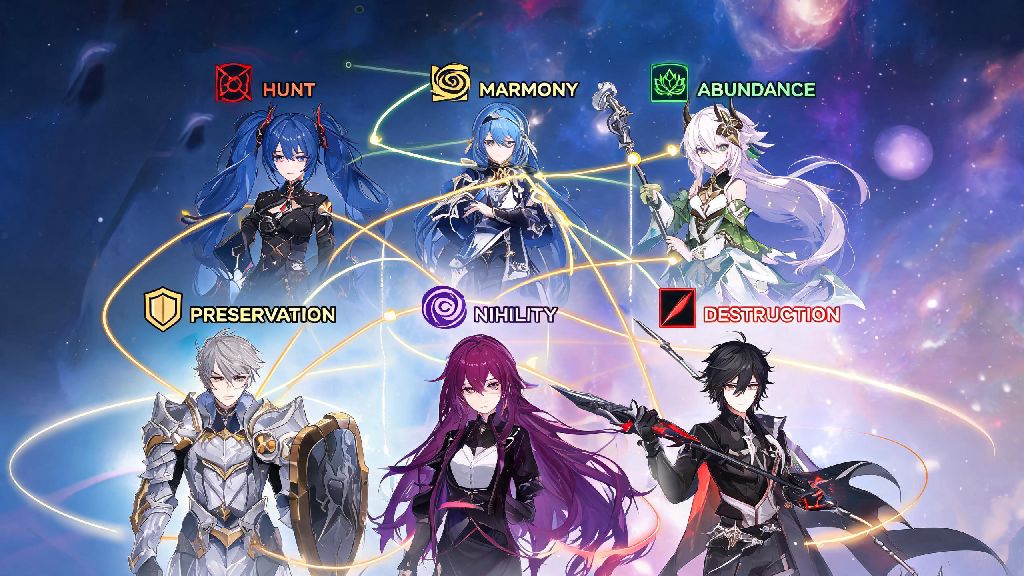
If you’ve ever stared at your character roster confused by the tiny icons below each unit’s name, you’re not alone. Thousands of new players ask how many paths are there in Honkai Star Rail every month, and what those paths actually mean for their team builds. I’ve been playing since launch, tested every path combination across all endgame modes, and I’m breaking down everything you need to know without all the confusing jargon. You don’t have to follow meta guides to the letter, but understanding paths will make clearing content way less frustrating.
How Many Paths Are There in Honkai Star Rail, Exactly?
First, let’s clear up the most common confusion players have around path counts. There are two separate types of paths in the game, so total official paths sit at 14, split evenly between two categories. Character class paths are assigned permanently to every playable unit, and define their core role in your team. Aeon bonus paths are used exclusively in roguelike modes like Simulated Universe, Pure Fiction, and Apocalyptic Shadow to give you temporary gameplay buffs. The 7 core character paths that define every unit’s role are:
What Each Core Character Path Means for Your Team Comps
Now that you know the core path count, it’s important to understand how each path actually works in practice, not just their basic definitions. For example, you might think running two Hunt characters for a boss fight is a good idea, but if you don’t have a Harmony or Abundance unit to back them up, you’ll likely get wiped before you can take the boss down. Most endgame teams follow a standard 1 damage dealer, 1 harmony, 1 utility (nihility or preservation), 1 healer structure, so you’ll want one unit from each relevant path for most comps. There are exceptions, of course. Some Destruction characters like Blade can act as both a damage dealer and a pseudo-tank, so you can swap out the Preservation unit for another Nihility or Harmony unit to boost damage even more. I tested this myself in Memory of Chaos floor 12 last season, running Blade, Ruan Mei, Bronya, and Luocha, and cleared with 3 stars on both sides without any shielder at all. That said, if you’re a new player with underbuilt characters, sticking to one unit per core path is the safest way to clear content without frustrating wipes. You don’t need to pull every limited 5-star character to build a solid team either; every path has great 4-star options that work just as well as many 5-stars if built correctly.
Common Path Misconceptions New Players Should Avoid
Even if you know how many paths are there in Honkai Star Rail, it’s easy to fall for common myths that make building your team way harder than it needs to be. The biggest one I see is that you need one of every path to beat endgame content. That’s not true at all. For example, if you have a very well-built Abundance healer like Huohuo that can also cleanse debuffs and provide small buffs, you don’t necessarily need a Preservation shielder for most content. Another common myth is that Nihility units are useless for new players. A lot of new players skip building Nihility units because they think only damage dealers matter, but units like Pela can reduce enemy defense by up to 40% with her ultimate, which makes your entire team deal almost twice as much damage for very little resource investment. I’ve helped dozens of new players clear their first MoC 3 star runs just by telling them to build a Pela instead of pulling for another 5-star damage dealer. One more thing to avoid: forcing a path that doesn’t fit your playstyle. If you hate waiting for buffs and just want to blast through content as fast as possible, you’ll probably have more fun running Erudition and Hunt focused teams, even if they aren’t the absolute meta for a specific floor. The game is designed to be flexible, so don’t feel like you have to follow every meta guide to the letter.
How to Pick the Right Path Mix for Every Game Mode
Different game modes reward different path combinations, so adjusting your team’s path mix for each activity will save you a lot of time and repair kits. For open world exploration, you can get away with almost any path mix, but I recommend running one Erudition unit for mob clearing, one Hunt unit for random elite enemies, one Abundance healer, and one Harmony buffer to make everything faster. You don’t need a shielder here, since open world enemies deal very little damage compared to endgame content. For Memory of Chaos, you’ll want to tailor your path mix to each side of the floor. If one side has a single boss with high health, run a Hunt main damage dealer, a Harmony buffer, a Nihility debuffer, and either a Preservation or Abundance unit to stay alive. If the other side has multiple waves of mobs, swap the Hunt for an Erudition unit instead. For Simulated Universe runs, you don’t have to match your team’s character paths to the Aeon path you pick, but it does help. For example, if you’re running a DoT team with Nihility characters, picking the Nihility Aeon path will give you far bigger bonuses than picking the Hunt path. That said, you can make almost any path work if you pick the right blessings. I once ran a full Hunt team with the Elation path and got a full clear just by picking all the follow-up attack blessings available. If you’re new and still figuring out how many paths are there in Honkai Star Rail, stick to the core 7 first before you dive into the Aeon paths for Simulated Universe.
At the end of the day, knowing how many paths are there in Honkai Star Rail is just the first step to building teams that work for your playstyle. You don’t have to memorize every single path’s niche immediately, but getting familiar with the 7 core character paths will help you make smarter pull decisions, build better teams, and clear content far faster than guessing. If you’re still confused, try testing different path combinations in the Simulated Universe first, where you don’t lose anything if you wipe, to see what works best for you.